TL;DRAI In Manufacturing Job Shops

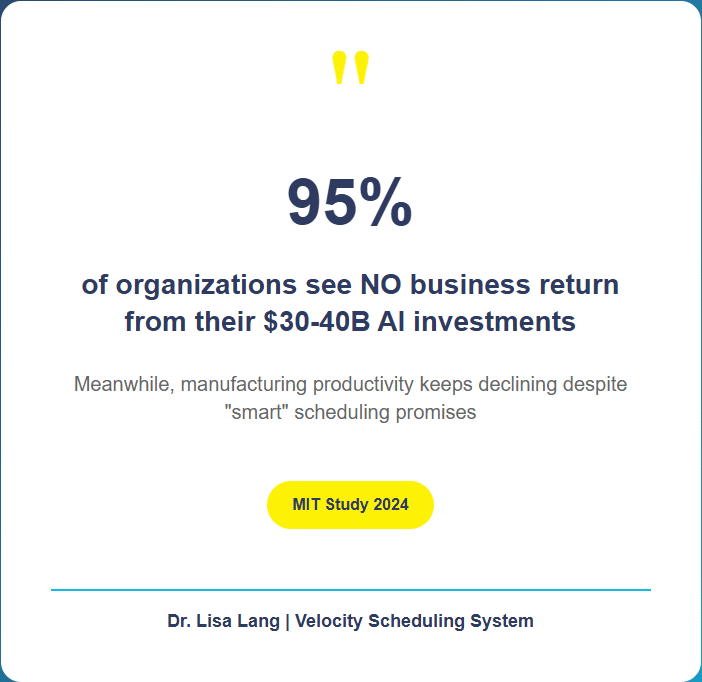
  • Your software vendors are making motor swaps – bolting AI onto the same broken logic. That is why 85-95% (MIT Study) of AI investments fail. Redesigning the factory is what works.
  • Your scheduler is probably your highest-leverage thinker trapped in lowest-leverage work. Eighty percent arithmetic, twenty percent judgment. You are starving the constraint.
  • Everything that made you a successful shop owner – keep machines busy, batch for setups, plan in detail – is trained incapacity for this environment. You have reached the George Costanza moment.
  • The rules that work for AI in manufacturing job shops: protect the constraint, not utilization. Release work based on constraint capacity. Priority is time-based, not importance-based.
  • Methodology alone drifts. Software alone becomes shelf-ware. Coaching alone lacks teeth. You need all three integrated.
  • When software enforces the rules, you stop being the cop. You lead instead of police.
  • The combination flips the scheduler’s day: 20% monitoring, 80% high-leverage decisions. That is where throughput (Throughput-margin) lives.

How to Leverage AI in Manufacturing Job Shops

That moment when your scheduler looks up from the screen and you can see the exhaustion behind her eyes. That is not a staffing problem.

The stack of hot jobs that grows faster than it shrinks. The customer call you have been avoiding because you do not have a good answer. The news that 85-95% of AI projects are failing, which leaves you wondering what the right move even is.

You read Part 1. You followed the logic. You saw what critical systemic
judgment looks like in something as straightforward as content creation — the difference between using AI as a tool and building a system that compounds over time. Now apply that same lens to your scheduling, your flow, your execution.

And if you are like most shop owners I work with, that realization was equal parts liberating and terrifying. Liberating because it finally explains why all the effort has not translated into results. Terrifying because it means the problem is not one more tool away from being solved.

The constraint has moved upstream. Not to a different machine. Into cognition itself.

AI increases potential throughput (Throughput-margin). Realized throughput is bottlenecked by critical systemic judgment. The shops that recognize this will dominate. The shops that keep optimizing downstream will fall behind.

You get it. Now you want to know what to DO about it.

This paper delivers the how-to. No theory rehash. No abstract frameworks. Concrete actions you can take in your shop, starting now.

But first, I need to show you something that will change how you think about everything happening around you. It explains why AI is failing everyone else – and what to do differently.


Why the AI Wave Is Not Helping You

You have probably noticed something frustrating.

Your existing software vendors are adding AI features. “AI-enhanced scheduling.” “Predictive analytics.” “Intelligent automation.” Every update promises transformation.

Meanwhile, the news tells you 85-95% of businesses investing in AI are seeing minimal returns. I’m sure you have played with AI some yourself. You can see the power and promise. But you are not sure what to do with it. And you are definitely not going to dump money into something that fails nine times out of ten.

So you wait. You watch. You wonder what the right move is.

Here is what nobody is telling you.

The problem is not the AI. The problem is where it is being applied.

In the 1880s, factories started replacing steam engines with electric motors. Same factory. Same floor plan. Same workflow. Just swap the power source.

Productivity did not budge. For forty years.

The technology worked perfectly. The motors were reliable, efficient, exactly as advertised. But nothing changed because factory owners bolted new technology onto old layouts. Same building design. Same workflow logic. Different motor.

It took four decades before someone realized the factory itself needed to be redesigned around what electricity made possible. Only then did productivity explode.

Now think about your last software update. The one with “AI-enhanced” in the release notes.

Same scheduling logic. Same ERP workflows. Same priority rules. Different automation underneath.

What does that remind you of? Motor swap.

Your vendors are making a motor swap. And they are selling it to you as transformation.

Think about what that means concretely. The same system that can’t even flag a negative inventory count – you have negative three of something on a shelf and nobody blinks – is now going to deliver intelligent scheduling insights?  The same system that lets sales orders sit open for months after shipment, inflating your backlog by hundreds of thousands of dollars, is going to optimize your priorities? You can’t bolt a smart brain onto a system that has no nervous system.

The AI works. Your shop layout doesn’t. And nobody selling you AI features has any incentive to tell you that.

This is why AI investments are failing. Not because AI does not work. Because organizations are making motor swaps instead of redesigning the factory.

Here is your opportunity. Your competitors are making motor swaps right now. They are buying “AI-enhanced” everything and wondering why nothing changes. While they bolt new technology onto old layouts, you can redesign. First mover advantage goes to whoever redesigns first.

So what does “redesign” actually mean in a job shop context?

It means moving the constraint exploitation upstream. It means recognizing that your scheduling and decision-making systems are the factory layout that needs to change.

Let me show you where to start.


The Scheduler Math Trap

I want you to do something tomorrow. Watch your scheduler for a full day. Not what their job title says they do. What they actually do.

Track their time in 15-minute blocks. Categorize every activity. I am going to tell you what you will find, but you will not believe it until you see it yourself.

Here is what you will find.

Eighty percent of their time goes to calculating priorities. Updating the whiteboard. Updating dispatch lists. Reconciling what the ERP says with what is actually happening on the floor. Creating travelers. Chasing down material status. Answering “when will my job be done?” from sales.

Arithmetic. Data reconciliation. Status chasing. Dispatch list updates.

Maybe twenty percent goes to actual thinking. Judgment calls about which job really needs to move. Figuring out how to recover from the machine that went down. Deciding whether to split a batch or run it whole. Uncovering flow and productivity improvement opportunities.

Now here is the part that should hit you like a punch in the gut.

Your scheduler is probably your highest-leverage thinker in the operation. They are the one who sees the whole picture. They understand flow. They know which customers scream and which ones are flexible. They know which operators work well together and which combinations create drama.

You have your highest-leverage thinker trapped in the lowest-leverage work.

Read that again.

This is the constraint-starving pattern from Part 1, showing up in your shop right now.

Your scheduler has critical systemic judgment. That is the bottleneck. And you are feeding it arithmetic instead of high-leverage decisions.

Every hour they spend updating a spreadsheet is an hour they are not spending on the decisions that actually move throughput. Every interruption to answer “where is my job?” is cognitive switching cost that degrades their ability to think about flow.

You are not exploiting the constraint. You are drowning it in administrivia.

This is the motor swap problem applied to your most valuable cognitive resource. You have someone who could be uncovering flow and productivity improvement opportunities, and they are stuck manually doing what software should automate.

I watched the moment this clicked for Mike at a precision machining shop in Ohio. Eighteen years with the company. Knew every customer’s quirks, every operator’s strengths, every machine’s tendencies. His wife told me later she knew something had changed because he stopped checking email at dinner.

For 18 years, his expertise was trapped. Not because he lacked knowledge. Because his days were consumed by arithmetic that software should have handled.

The fix is not to hire a second scheduler. The fix is to automate the arithmetic so your scheduler can do what only humans can do: apply critical systemic judgment to the decisions that matter.

Your competitors’ schedulers are drowning in arithmetic right now. Their best thinkers are trapped doing the lowest-leverage work. If you free yours first, you gain the advantage.

But knowing the fix and executing the fix are different problems. And here is where your expertise becomes your obstacle.


Why Your Instincts Are Betraying You

Now here is where it gets uncomfortable.

Everything you learned about running a successful shop is working against you.

Economist Thorstein Veblen identified this pattern in 1914. He called it “trained incapacity.” When you develop deep training for one environment, that training makes you specifically incapable in a fundamentally different environment.

Not generally less capable. Specifically incapable. Your neural pathways fire automatically, producing the wrong responses before you can think.

Your instincts were trained for a different environment. And the environment has changed.

Seinfeld fans will remember the episode where George Costanza realized every instinct he had was wrong. He started doing the opposite – and his life transformed. That is trained incapacity in sitcom form.

Think about what made you successful:

Keep every machine running. Idle equipment feels like waste. When you see that machine sitting idle or an operator without work, something in your gut tightens. You want to push work out there. Fill the gap. Make it efficient.

But here is what happens. If every inch of highway is covered by cars, that is 100% utilization. It is also a parking lot. Movement requires empty space.

It sounds like heresy, I know. That idle machine feels like waste. But that idle machine is the lane that lets everything else move.

When you keep every machine busy, you create a parking lot. Work piles up everywhere. Queues form at every work center. Your “efficiency” is actually creating WIP chaos that buries your constraint. The jobs that matter get stuck in traffic.

The tightness in your gut when you see that idle machine? That is your training betraying you.

Batch for setup savings. Larger batches mean fewer setups. Fewer setups mean more run time per machine. The math works. Your spreadsheet proves it.

But batching extends lead times by days or weeks. Those batches sit in queue, waiting, while the customer wonders why a three-day job takes three weeks. You saved $200 in setup time and created $20,000 in delayed shipments. The setup savings are real. The flow destruction is bigger.

That satisfied feeling when you combine jobs into a big batch? That is trained incapacity releasing dopamine.

Plan in detail before acting. Good managers plan thoroughly, right? MRP logic says calculate everything, then execute the plan. You feel in control when the schedule is locked.

But by the time your detailed plan hits the floor, reality has changed. Machine down. Material late. Hot job inserted. Your plan is stale before you start. And replanning takes more time than executing.

That sense of control from detailed planning? An illusion your training manufactured.


Here is a quick test. When you walked the floor this morning and saw a machine sitting idle, what was your first instinct?

A) Push more work out to fill it
B) Ask why it is idle and whether the constraint is fed

You answered A. I know you did, because that is what 20 years of running a successful shop trained into you. That response is not a thought. It is a reflex. Your expertise firing before your brain engages.

Everything that made you a successful shop owner trained you to be specifically incapable in this new environment. You have reached the George Costanza moment.

Here is your new decision rule. Next time you walk the floor and see that idle machine and your gut tightens – that tightness IS the trained incapacity firing. The moment you feel it, ask yourself: Is the constraint fed? If yes, the idle machine is doing exactly what it should.

Your competitors will keep chasing utilization. They cannot help it. Their training will not let them stop. While they create parking lots, you can create flow.


This is not a character flaw. This is how expertise works. The patterns that made you money for twenty years are now costing you money every day.

The shift is not that you need to try harder. The shift is that you need different rules.

And here is the uncomfortable truth: knowing the rules is not enough. You need something to enforce them when your trained instincts scream the opposite.


What trained incapacity is costing you every single week:

  • The “keep machines busy” reflex that feels productive until you realize it is creating the WIP pile-up killing your due date performance
  • The batching habit that saves $200 in setup time while quietly adding weeks to your lead times, until the customer finds someone faster
  • The MRP devotion that produces beautiful plans nobody can follow, until you see the floor doing something completely different by Tuesday afternoon
  • The “more data” instinct that buries your scheduler in reports, until you notice the real constraint went unnoticed for another month
  • The open order report your scheduler just used to reprioritize 200 jobs, until you discover that $800,000 of that backlog shipped months ago and was never closed out – your scheduler is sequencing work against a backlog that is partly fiction, and every priority call built on ghost data starves a real job
  • The utilization numbers your best operator posts that look great on paper, until you trace the queue he is creating that starves everything downstream
  • The scheduling trick experienced planners use “because it always worked,” until you calculate the two weeks it adds to every job
  • The improvement initiative that won you an award in 2015 that now costs you throughput, until you see how the environment shifted under your feet

The Rules That Actually Work

Theory of Constraints has known this for decades. Flow-based scheduling beats efficiency-based scheduling. Exploit the constraint, subordinate everything else.

But knowing the rules and executing the rules are different things.

Here is what the rules actually look like in practice:

Rule 1: Protect the constraint, not utilization.

Your constraint resource should never wait for work, never wait for materials, never wait for information. Everything else can wait. Everything else should wait if that is what protecting the constraint requires.

This means deliberately having some machines idle sometimes. It means not filling every gap with work. It means accepting that utilization at non-constraints does not matter.

The issue is that you are trying to be efficient everywhere, which starves the one place efficiency actually matters.

Rule 2: Release work based on constraint capacity, not sales orders.

Do not dump everything onto the floor and let people figure it out. Release work at the pace the constraint can process it. Control the input to control the flow.

This is Drum-Buffer-Rope in action. The constraint sets the pace. Everything else follows.

Rule 3: Priority is time-based, not importance-based.

When a job is late to buffer, it is red. When it is on track, it is green. Period. No judgment calls about which customer is more important. No heroic expediting that disrupts everything else. Simple color coding that anyone can follow.

This removes the scheduler from the priority decision. The math determines priority. The scheduler focuses on exceptions and opportunities.

Rule 4: Data serves decisions, not reports.

Your ERP captures history. What actually matters is what is happening now and what is about to happen next. Real-time visibility into flow beats retrospective analysis of efficiency.

These rules are simple. Deceptively simple. Because the execution is where everyone struggles.


Why Methodology Alone Drifts Over Time

Here is what happens to shops that learn these rules but try to implement them without ongoing support.

Year one: Energy is high. Everyone follows the new approach. Results are promising.

Year two: A few hot jobs required exceptions. The old habits reasserted themselves here and there. The rules bent but held.

Year three and beyond: Gradual drift. New people who were not there for the original training. Customers who learned they could get exceptions. The rules eroded slowly enough that nobody noticed until results started slipping.

Many VSS implementations are ongoing to this day. Shops see results, and they know that ongoing coaching prevents drift. The methodology works. The question is whether you have the structure to maintain it.

The methodology does not fail. The enforcement mechanism matters.

This is the insight that changes everything: You need three things working together, not one.

Methodology gives you the rules.
Software enforces the rules.
Coaching prevents drift.

Miss any one and the system weakens. Learn the rules without software? Champion burnout trying to enforce manually. Buy software without understanding why? Expensive shelf-ware. Get both without ongoing guidance? Gradual regression to old habits.

This is why coaching alone does not stick forever. And why software alone does not work. And why DIY implementation has such a high failure rate over time.


The 80/20 Flip That Happens in Week One

Let me be specific about what changes when you combine flow-based methodology with software enforcement.

The scheduler’s day inverts.

Before: 80% arithmetic, 20% judgment.
After: 20% system monitoring, 80% high-leverage decisions.

The software calculates priorities. The software tracks where every job is relative to its due date. The software answers “where is my job?” The scheduler focuses on exceptions, opportunities, and flow improvement.

Within three weeks of implementation, Mike said something I have heard dozens of times: “I’m finally doing the job I was hired for.” Instead of updating travelers and fielding status calls, he was identifying flow bottlenecks before they became emergencies. Spotting opportunities to combine setups that nobody else would have noticed. Actually using that 18 years of knowledge.

Their throughput increased 47% in 90 days. Not because Mike worked harder. Because Mike finally worked on what mattered.

Like the aerospace shop in Michigan that went from six-week lead times to ten days. Same machines. Same people. Same customers. Different layout. The owner told me, “We didn’t get faster. We stopped being slow.” They had been creating their own delays for years without seeing it.

The floor operators’ reality changes.

Before: Ask the scheduler. Wait for priorities. Interpret the whiteboard. Guess at what matters.
After: Look at the screen. See the color. Work the red jobs first. No interpretation required.

Simple rules that anyone can follow. No judgment calls about which job is more important. The system handles priority. Operators handle execution.

The decision speed changes.

Before: Wait for the scheduler to update the plan. Wait for the meeting to discuss priorities. Wait for consensus on what to expedite.
After: Real-time priority updates. Immediate visibility into where every job stands. Decisions happen at the point of action.

The data reality changes.

Before: ERP captures what happened. Reports show what went wrong. Analysis happens after the fact, and sometimes not at all.
After: Real-time flow visibility. You see where jobs are relative to due dates. Problems surface when there is still time to act.

The improvement process changes.

Before: Fight fires all day. Try to improve when there is time. Never have time.
After: System surfaces improvement opportunities. Scheduler has cognitive bandwidth to act on them. Improvement becomes systematic.


What your Monday morning actually looks like after this shift:

You walk in. The screen shows you which jobs need attention, color-coded by urgency. No meetings required to figure out priorities. No scheduler drowning in “where is my job?” calls.

Your operators already know what to work on. Your scheduler is focused on the three exceptions that actually need human judgment, not the hundred routine decisions that software handles.

The question your operators used to ask 30 times a day, “what should I work on next?”, nobody asks anymore. And that silence means everything is working.

You have time to think. Time to improve. Time to run your business instead of fighting fires.


The Specific Mechanism: How VSS and iVSS Create This

VSS is the methodology. Fifteen years of refinement across 550+ shops. Drum-Buffer-Rope implementation adapted for job shop reality. Coaching to install the thinking, not just the techniques.

Here is the part nobody talks about.

When you install a methodology without software enforcement, YOU become the enforcement mechanism.

You know exactly what this feels like. The operator who “just this once” wants to run the big batch because it is more efficient. The scheduler who quietly reverts to the old priority system when you are not looking. The sales rep who promises a rush job without checking capacity.

Every deviation, you catch it. Every shortcut, you correct it. Every “just this once,” you fight it.

You become the cop.

And cops burn out. Not from the work. From the weight of being the one person standing between the new way and the gravitational pull of old habits. From having the same conversation for the third time this week. From watching your own energy drain into enforcement instead of improvement.

Now imagine the rules live in software instead of you.

The system will not let them release work out of sequence. The board shows priorities that cannot be argued with. The process enforces itself.

You stop being the cop.

You do not spend time and energy making sure people follow the system. The software does that. You lead instead of police.

Your competitors are burning out their champions right now. Their best people are exhausted from manual enforcement. When their implementations drift – and they will – yours will not. That is an advantage that compounds over time.

The software automation handles all the mundane tasks your scheduler used to do manually.

That frees up the 80% of your scheduler’s time that used to go to arithmetic and enforcement. And this is where the AI components come in.

The Velocitizer continuously accelerates flow by identifying and eliminating micro-delays in real-time. It adapts as shop conditions change, optimizing to balance productivity with on-time delivery.

The Correlizer is AI-powered pattern discovery. It runs automatically, finding correlations across your production data that you would never see manually. Your scheduler can also initiate investigations and query the data, looking for flow and productivity improvements.

Together, they help your scheduler get the most out of that freed-up time – looking for patterns, finding opportunities for flow and productivity improvements. Instead of drowning in spreadsheets, they are finally doing the high-leverage thinking you hired them for.

The electronic Velocity Board shows every job’s status with Green/Yellow/Red priority zones. Simple signals that tell everyone what needs attention. No interpretation required. Operators see the color, work the priorities.

The combination breaks the drift pattern. The methodology provides the rules. The software enforces them. The coaching prevents regression.

This is what redesigning your operation looks like. Not a motor swap. An actual layout change.


Why This Specific Path

You might be thinking: “TOC is not new. Drum-Buffer-Rope is not new. Why can I not just learn this myself?”

Here is the problem. Most shops do not succeed with DIY implementation. And VSS is not off-the-shelf TOC that you can study on your own. It is customized for complex job shops where the constraint moves. It is not in the public domain.

Here is what 15 years of data shows:

The combination is what works. Methodology alone drifts over time. Software alone becomes shelf-ware without understanding. Coaching alone lacks enforcement teeth. You need all three, integrated.

The refinement cycle matters. VSS has been refined across 550+ implementations. Every failure mode has been encountered and addressed. Every objection has been answered. Every edge case has been handled. DIY means rediscovering all of this yourself.

The adaptation matters. Generic TOC consulting applies theory. VSS applies job-shop-specific implementation, refined over 15 years of nothing but job shops. The difference is in the details that only emerge from repetition.

Other TOC consultants exist. Other scheduling software exists. But the specific combination of methodology + software + ongoing coaching, refined across 550+ job shop implementations, does not exist elsewhere.


The Results When This Clicks

Let me be specific about what shops see when they implement this correctly.

Average productivity improvement: 198% (customer-reported across the VSS population).

That is not a typo.

Typical WIP reduction: 87%.

Less work in process means shorter lead times. Less cash tied up in inventory. Less chaos on the floor. Faster response to changes.

Typical lead time reduction: 82%.

Customers get their parts faster. Sales can promise tighter windows. Competitive advantage in markets where speed matters.

These numbers come from a study of 442 job shops that implemented VSS. 550+ shops have implemented since 2008. Fifteen years of data. Not a pilot program. Not a handful of success stories. A systematic pattern across hundreds of shops.


What Now?

Remember the question you had at the beginning? How to leverage AI when 85-95% of AI projects fail?

This is your answer.

Not another software demo. Not another vendor promising transformation while bolting AI onto broken logic. Not another motor swap.

VSS+iVSS is the redesign. The methodology changes how you think. The software enforces compliance so you are not the cop. The AI – The Velocitizer and The Correlizer – amplifies your scheduler’s freed-up judgment instead of replacing it.

And here is what makes it stick.

The core concepts are trained in less than a day. Not fourteen weeks of videos you never finish. Not a binder that collects dust. One day to understand the rules.

Then the software reinforces those concepts just-in-time, every single day. When your scheduler is about to release a job, the system reminds them of the right question to ask. When an operator looks at the board, the colors tell them exactly what to do. The learning happens in the moment it matters.

That is why it sticks. These concepts are counterintuitive. They go against everything your training taught you. One exposure is not enough. You need multiple exposures over time to cement new thinking. The software provides those exposures automatically, in context, when they matter.

And weekly group coaching catches drift before it becomes habit. The coaching evolves as you evolve – what you need in month one is different from what you need in month six.

This is how you leverage AI in your shop: by redesigning the operation so AI amplifies your critical systemic judgment instead of automating your broken rules.

But waiting has a cost.


What happens when you keep waiting:

  • Your competitor down the road, the one who just poached your best welder, cuts their lead time in half while you are still explaining delays, until you lose the customer you thought was loyal
  • The scheduler you have been training for five years burns out on arithmetic and leaves, until you realize their replacement will take another five years to understand what they knew
  • Your ERP vendor releases another “AI enhancement” that bolts more technology onto the same broken process, until you stop expecting different results
  • Next quarter’s efficiency numbers look fine on paper while throughput stays flat, until someone asks why you are so busy but not making more money
  • The customer who has been loyal for a decade quietly shifts their second-source orders to the shop that delivers in two weeks instead of six, until second-source becomes primary and you hear about it too late

Schedule a Strategy Session

Here is my offer.

Schedule a strategy session. On the call, we will look at your specific situation and determine whether VSS+iVSS is a fit for your shop.

We take 10 new shops per quarter for full implementation. I do not know where we are in the current quarter, but the strategy session will tell you whether this path makes sense for your shop.

The constraint has moved upstream. Your competitors are figuring this out.

The question is not whether to adapt. It is whether you adapt before they do.

Schedule your Strategy Session


Frequently Asked Questions

Why do 85-95% of AI projects fail in manufacturing?

AI projects fail because organizations bolt AI onto broken logic – what we call “motor swaps.” Just like factories in the 1880s that replaced steam engines with electric motors but kept the same floor plan and saw no productivity gains, today’s manufacturers add “AI-enhanced” features to the same ERP workflows and scheduling rules. The AI works, but the underlying system logic doesn’t. Productivity only explodes when you redesign the operation around what AI makes possible.

What is the scheduler math trap?

The scheduler math trap is when your highest-leverage thinker spends 80% of their time on arithmetic – calculating priorities, updating dispatch lists, reconciling ERP data, creating travelers, chasing material status. Only 20% goes to actual judgment calls. You’re starving the constraint by feeding it low-leverage work instead of high-leverage decisions that move throughput.

What is trained incapacity and how does it affect job shops?

Trained incapacity is when expertise in one environment makes you specifically incapable in a fundamentally different environment. Job shop owners trained to “keep every machine running” and “batch for setup savings” are now working against themselves. These instincts worked for 20 years but now create WIP chaos, extend lead times, and starve the constraint. The tightness you feel when you see an idle machine? That’s your training betraying you.

What rules actually work for AI-enabled job shops?

Four rules work: (1) Protect the constraint, not utilization – your constraint should never wait for work, materials, or information. (2) Release work based on constraint capacity, not sales orders – control input to control flow. (3) Priority is time-based, not importance-based – red/yellow/green buffer status removes judgment calls. (4) Data serves decisions, not reports – real-time flow visibility beats retrospective efficiency analysis.

Why does methodology alone drift over time?

Year one shows energy and results. Year two sees exceptions bend the rules. Year three brings gradual drift as new people join, customers learn to get exceptions, and rules erode. You need three things integrated: methodology gives you the rules, software enforces the rules, and coaching prevents drift. Miss any one and the system weakens. When software enforces the rules, you stop being the cop – you lead instead of police.

What is throughput in Theory of Constraints?

In Theory of Constraints, Throughput specifically means Throughput-margin: the rate at which the system generates money through sales, minus truly variable costs. It is not revenue, and it is not units produced. AI increases potential throughput, but realized throughput depends on the organization’s ability to exploit the constraint effectively.

What is the George Costanza moment in manufacturing?

In the Seinfeld episode “The Opposite” (watch the clip), George Costanza realizes every instinct he has is wrong. He starts doing the opposite of his instincts – and his life transforms. Job shop owners face the same moment: everything that made them successful (keep machines busy, batch for setups, plan in detail) is now working against them. The trained incapacity that served them for 20 years now creates WIP chaos and extended lead times. The tightness you feel when you see an idle machine? That’s your training betraying you. You’ve reached the George Costanza moment.


“Dr. Lisa” Lang is President of Science of Business, a TOCICO Certified Expert, TOCICO Lifetime Achievement Award recipient,Dr Lisa Lang and Dr Eilyahu M Goldratt and Past Chairman of the Board of TOCICO. She holds a PhD in Engineering Management from the University of Missouri-Rolla with an emphasis in Manufacturing and Packaging. She was trained by Dr. Eli Goldratt, the father of the Theory of Constraints and author of The Goal, and served as his Global Marketing Director. She has been named a “Manufacturing Trendsetter” by USA Today and a “Manufacturing Champion” by Newsweek.

Since 2008, she has applied TOC-based throughput thinking to 550+ job shops through the Velocity Scheduling System (VSS). A 2020 study of 442 VSS shops showed mean results of 198% productivity increase, 87% WIP reduction, 42% on-time delivery increase, and 82% lead time reduction.

VSS now includes AI-enabled software (iVSS) that automates the mundane, freeing up schedulers and managers to apply their critical systemic judgment to high-leverage opportunities – utilizing built-in AI that scours for flow improvement opportunities. To learn more, visit velocityschedulingsystem.com.

Pin It on Pinterest