
Originally published February 1, 2026 | Updated August 2026
Critical Systemic Judgment (CSJ) is the capability that determines which problems are worth solving, how they are framed, and whether a system’s design produces throughput or noise. When AI automates execution, the constraint moves upstream to exactly this judgment: framing, problem selection, and system design. Understanding that shift is what separates AI implementations that increase throughput from the 85-95% that fail.
TL;DR – Critical Systemic Judgment
- AI does not eliminate constraints. It moves them upstream.
- When execution becomes cheap, the bottleneck is no longer speed or tools. It’s problem selection, framing, and system design.
- Human attention matters, but attention is just input. Critical systemic judgment determines whether that attention produces throughput or noise.
- AI amplifies existing critical systemic judgment and rapidly exposes its absence. Good judgment compounds. Bad framing fails faster.
- When critical systemic judgment constrains throughput, it signals system immaturity or poor design. It may need to be managed in the short term, but it is not a strategic constraint to be accepted.
- Critical systemic judgment is a governing capability: it exists to enable reliable exploitation of the organization’s intended constraint, not to remain the constraint itself.
- Most organizations make the same mistake: they distribute AI evenly in the name of fairness. That dilutes leverage and amplifies noise.
- TOC has always been clear: you exploit the constraint. In AI-enabled organizations, that requires identifying, protecting, and elevating critical systemic judgment so the constraint can be placed where it belongs.
Attention vs Critical Systemic Judgment
This document presents my analysis of a growing claim in AI discourse: that attention (or simply “humans”) will become the primary constraint as AI tools eliminate execution bottlenecks. I argue that this framing is incomplete. From a Theory of Constraints (TOC) perspective, the true constraint is better described as critical systemic judgment. Boundary condition (explicit): This analysis intentionally focuses on the internal constraint of a business once AI access exists, not on macro supply constraints such as energy, compute, regulation, data infrastructure, or geopolitics. The goal is to articulate the dominant constraint governing throughput inside an AI-enabled organization, based on direct experience and TOC-based reasoning.
The Common Claim Being Challenged
A widespread belief in AI and entrepreneurial circles is:
- AI removes execution and production bottlenecks.
- With modern AI tools, anyone can build agents, systems, analysis, and content rapidly.
- As these tools commoditize, success becomes a function of where and how much attention a person applies, or simply the presence of a human in the loop.
In short: once tools are abundant, attention (or humans) becomes the constraint.
Why Attention Is Necessary but Not Sufficient
Attention matters. Focus matters. But attention alone does not explain observed outcomes. Across manufacturing, consulting, and knowledge work, the pattern is consistent:
- Two people apply similar time and attention.
- One materially advances the system; the other does not.
- The difference is not effort. It is how the person thinks.
This mirrors manufacturing reality:
- Some operators competently change parts.
- Others redesign flow, surface root causes, and improve the system.
- No amount of attention converts the former into the latter.
AI tools amplify this difference rather than eliminate it.
Why “Humans” Is Also an Inadequate Constraint
Some argue the constraint is simply “humans.” This framing fails operationally.
- Humans are not interchangeable.
- Capability varies widely even among trained professionals.
- Placing any human in front of advanced AI tools does not produce strategic progress.
Saying “the human is the constraint” is too coarse to guide decisions about hiring, training, or system design. To address this, we need a more precise and operationally useful lens: critical systemic judgment.
The Governing Bottleneck: Critical Systemic Judgment
From a TOC perspective, this can be expressed as a necessary condition: For an AI-enabled organization to increase throughput, sufficient critical systemic judgment must exist to identify, frame, and exploit high-leverage opportunities. Or more compactly: AI increases potential throughput; realized throughput is often bottlenecked by critical systemic judgment. To understand this constraint, we must distinguish it from general intelligence or task execution. In low-complexity or fully specified work, execution efficiency, not critical systemic judgment, is the binding constraint. Critical systemic judgment refers to the capacity for high-quality critical thinking to frame, prioritize, and steer work across complex, feedback-driven systems under uncertainty. It is the combination of:
- Insight (seeing what matters)
- Reasoning (structuring problems and implications)
- Discernment (knowing what not to pursue)
- Curiosity (asking progressively better questions)
- Persistence (iterating until the thinking is sound)
- Directed focus applied to high-leverage points
These attributes, taken together, don’t reflect raw capacity. In TOC terms, they represent leverage per unit of cognitive effort. It is identified operationally by its disproportionate impact on system throughput and rate of improvement. Critical systemic judgment is not a strategic constraint to be accepted, but a governing capability that may need to be managed in the short term and deliberately elevated so the organization can reliably exploit its intended strategic constraint. Many frameworks describe these capabilities as “skills” that can be trained. From a TOC perspective, this is incomplete. Skills raise the floor; constraints determine the ceiling. Critical systemic judgment is not merely a skill set. It governs how much leverage any skill or tool can produce until the true system constraint is fully exploited.
Fixed vs Developable Capability
Critical systemic judgment is not purely innate, but it is also not fully transferable.
- Tools and training can raise the floor.
- They do not equalize the ceiling.
AI can scaffold execution and assist reasoning, but it does not replace:
- Problem framing
- Hypothesis selection
- Strategic judgment
Critical systemic judgment can be increased marginally, but it remains unevenly distributed. Two individuals can display identical competence at execution and radically different capacity for system redesign. Only the latter removes constraints. TOC clarification: Training is a necessary but insufficient condition for participation. Critical systemic judgment is the necessary governing condition for throughput once AI access exists.
Capability vs Role Suppression
Observed differences are not solely about innate ability. In many organizations:
- Roles discourage deep thinking.
- Incentives reward compliance over exploration.
- Systems actively suppress critical systemic judgment.
This analysis applies most clearly when individuals are permitted and expected to think. AI does not fix organizational design problems. It exposes them.
Early vs Mature AI Dynamics
Some variance reflects early-adopter dynamics. But the long-term pattern is predictable:
- As tools commoditize, advantage shifts upstream.
- Execution becomes cheap.
- Problem selection, framing, and system design dominate outcomes.
AI does not eliminate constraints. It moves them upstream into cognition.
What This Assumes (Explicitly)
- Baseline domain competence in professional contexts.
- Comparable access to AI tools.
- Freedom to explore and improve systems.
The analysis explains why, under similar conditions, outcomes still diverge sharply.
Observable Signals of Critical Systemic Judgment
Critical systemic judgment is not abstract. It is visible:
- Quality of questions asked
- Speed to reframing vs speed to output
- Willingness to discard low-leverage paths
- Depth of iteration before convergence
- Ability to design systems rather than produce artifacts
- Ability to design feedback loops and self-improving systems
AI magnifies these signals. To place them in strategic context, we need to understand where this constraint sits relative to others.
What CSJ Looks Like in Practice
Consider something as straightforward as content creation. Two shop owners decide to use AI for marketing. Both have the same tools. Both spend the same time. Watch what happens.
**Shop A** opens ChatGPT and starts prompting. “Write me a blog post about precision machining.” Ten posts a day. Professional-sounding. Grammatically correct. Generic enough to have come from any shop in the country.
**Shop B** pauses before prompting. Asks a different set of questions first. Not “what content should I create?” but “what system would produce content that compounds over time?” That question changes everything that follows. Shop B builds a system. The AI agents are trained on the company’s specific brand, voice, target avatar, and capabilities — not generic manufacturing language. Multiple copywriting agents are assigned distinct personas, because research shows this produces 30% better output than simple roles like “you are a world class copywriter.” Those agents compete against each other in multiple rounds, because research shows competition improves results. Validation and truth critic agents make sure the copywriters produce as expected and don’t hallucinate. A feedback loop captures what worked and what didn’t in each round, what was better about the winner’s content, so every run produces better output than the last. When new techniques or research are discovered, they’re evaluated and incorporated, compounding the advantage. The copy is getting better and better with less human intervention. This takes a little longer to set up than just prompting. But once built, the output is far superior — and the rate of output is equivalent.
Shop A produced content. Shop B built a content engine that improves every time it runs. But here is where the gap gets interesting. Shop A measures success by output. Ten posts today. Ten more tomorrow. Volume feels like progress. Shop A never asked what happens after the content exists, whether anyone reads it, whether it reaches the right prospects, or where the next bottleneck will appear once content is no longer the problem. Shop A solved one link in the chain and stopped thinking.
Shop B asked the question Shop A never considered: “What happens after the content exists?” Content that nobody reads is noise, regardless of how well it is written. So Shop B’s system does not stop at creation. It includes distribution — where does this content go, who sees it, how does it reach the prospects who would actually respond? It includes targeting — which topics address actual buyer concerns versus which ones just sound impressive? It includes measurement — not vanity metrics, but signals that connect content to pipeline. Shop B designed for the entire chain. Creation, distribution, targeting, feedback. Each component informs the others. The system learns what content actually produces results and makes more of that.
Six months later, Shop A has 300 blog posts and no measurable pipeline impact. Shop B has fewer posts but a system that reliably generates qualified interest — and gets better at it every quarter.
Same tools. Same time invested. Radically different outcomes. The difference was not effort. It was not the AI. It was the thinking that designed the system before the first prompt was ever written.
And it was the curiosity that kept improving the system after it was built. One of the most frequent questions the person with critical systemic judgment asks AI is: “How can we make this better?” That thinking — the ability to see the whole chain, design for compounding, and build systems rather than produce artifacts — is critical systemic judgment in practice.
To place these signals in strategic context, we need to understand where this constraint sits relative to others.
Constraint Layers by System Boundary
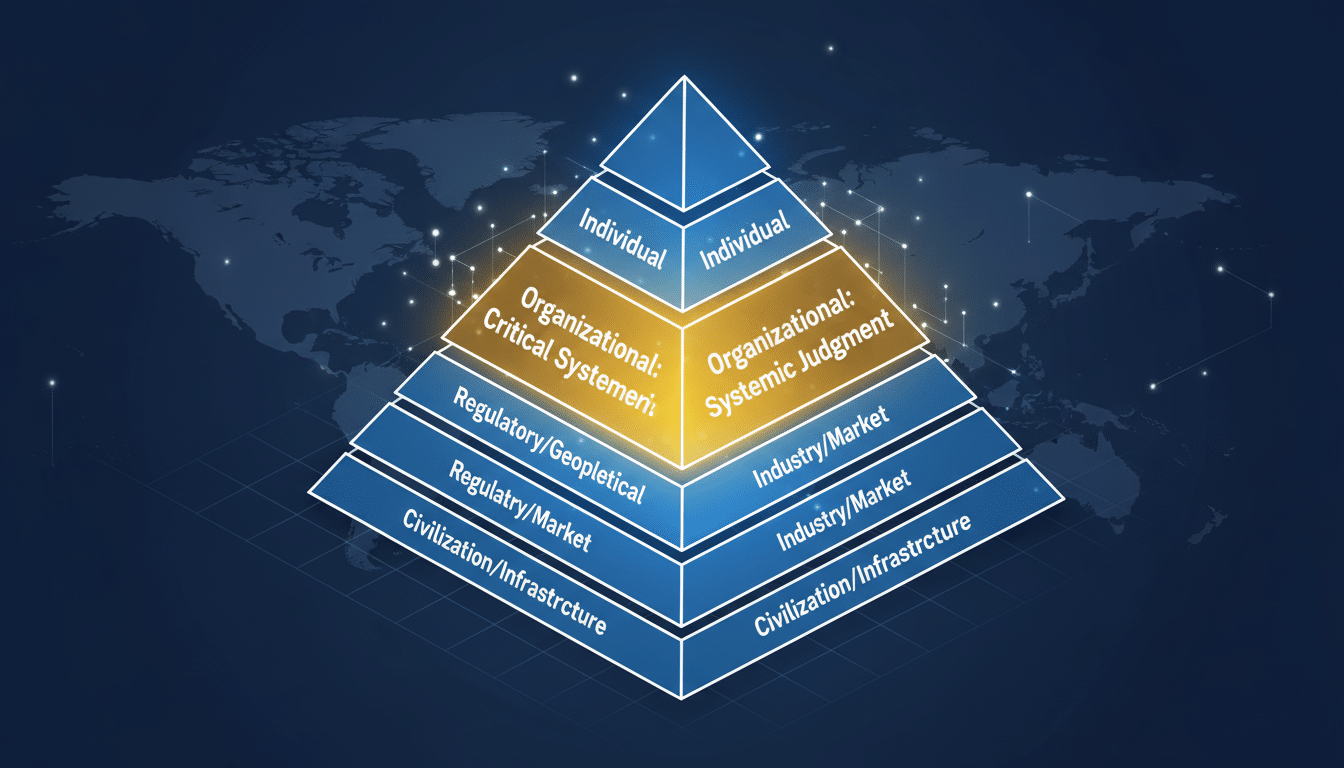
Different system boundaries produce different dominant constraints. Confusing these leads to category errors.
- Civilization / Infrastructure level: energy availability, compute, chips, power grids
- Regulatory / geopolitical level: regulation, liability, export controls, governance
- Industry / market level: data access, demand saturation, distribution, attention economics
- Organizational level (this paper’s focus): critical systemic judgment as the governing bottleneck
- Individual level: judgment, reasoning quality, curiosity, focus
This paper addresses the organizational-level internal constraint.
Bottom Line
- It is not just attention.
- It is not just humans.
The true constraint in an AI-enabled system is: Critical Systemic Judgment Attention is necessary. Humans are necessary. Only critical systemic judgment moves the system forward.
Critical Systemic Judgment: Leadership Implications
Purpose
This section translates the core constraint identified above – critical systemic judgment – into direct, operational implications for leaders. This is not an AI tooling discussion. It is a constraint exploitation discussion.
Core TOC Assertion
AI increases potential throughput. Realized throughput is often bottlenecked by critical systemic judgment in AI-enabled organizations. Therefore: Any AI deployment strategy that does not explicitly identify and exploit critical systemic judgment is structurally mis-designed.
The Primary Leadership Error
Most organizations deploy AI based on an implicit but false assumption: If everyone has the same tools, everyone will create comparable value. This assumption violates TOC.
- Constraints are not evenly distributed.
- Leverage is not evenly distributed.
- Treating non-constraints as if they were constraints suppresses throughput.
When leaders optimize for fairness, access, or optics instead of leverage, they subordinate the system to non-constraints.
Hiring Implications (Stop Hiring for the Wrong Thing)
Common hiring focus:
- Tool familiarity
- Speed of execution
- Compliance with process
- Keyword-matched resumes
These are non-constraint traits in an AI-enabled system. What actually matters:
- Ability to frame ambiguous problems
- Willingness to discard low-leverage paths
- Depth of reasoning under uncertainty
- Judgment about what not to pursue
If hiring does not explicitly test for these, the organization is importing noise into the constraint. But even when the right individuals are hired, their impact can be nullified by poor role design.
Role Design Implications (Where Throughput Is Silently Destroyed)
Individuals with strong critical systemic judgment are routinely placed into:
- Over-specified roles
- Execution-only jobs
- KPI cages that reward activity over insight
When critical systemic judgment is trapped in execution roles, the constraint is starved, not exploited, resulting in lost throughput. Critical systemic judgment is often the internal bottleneck; authority determines whether it can be exploited to increase throughput. This is a classic TOC violation: The system is subordinated to the non-constraint. Implication:
- Some roles must exist primarily for exploration, framing, and system redesign.
- Not all roles should be democratized.
- Equality of access is not equality of responsibility.
Suppressing critical systemic judgment does not create stability. It creates stagnation. This same pattern appears in how most organizations deploy AI: they flatten leverage instead of amplifying it.
AI Deployment Implications (Why Most Rollouts Underperform)
Typical rollout pattern:
- Broad access
- Generic training
- “Experiment and share learnings”
Observed outcome:
- Incremental gains
- Noise disguised as innovation
- Frustration that AI “didn’t live up to the hype”
Correct TOC-aligned sequence:
- Identify where critical systemic judgment already exists.
- Give those individuals disproportionate AI power.
- Allow system-level improvements to propagate outward.
AI should amplify the constraint, not dilute it.
This Is Not a Training Problem
Training raises the floor. It does not equalize:
- Judgment
- Curiosity
- Reasoning depth
- Willingness to think instead of execute
Believing otherwise confuses capability development with constraint exploitation.
Organizational Resistance Is Predictable
Organizations struggle to operationalize this logic because:
- It violates egalitarian instincts.
- It creates visible asymmetry.
- It forces hard decisions about people and roles.
TOC has always required this discomfort. Avoiding it does not make the constraint disappear – it ensures it remains binding.
Diagnostic Questions for Leaders
If critical systemic judgment is the constraint, leaders should be able to answer:
- Who in this organization consistently reframes problems rather than executes tasks?
- Who reliably eliminates low-leverage work?
- Who improves systems instead of producing artifacts?
- Where are those people currently constrained by role design, incentives, or workload?
If these answers are unclear, the constraint is unmanaged. These questions provide a concrete way for leaders to locate and assess critical systemic judgment in their current systems.
Bottom Line
AI does not reward fairness. AI rewards leverage. Organizations that distribute AI evenly will dilute their gains. Organizations that identify, protect, and exploit critical systemic judgment will dominate.
AI Constraint Doctrine
Executive Doctrine: AI and the Real Constraint
AI dramatically increases what is possible inside an organization. It does not guarantee improved results. From a Theory of Constraints perspective, AI does not eliminate constraints. It relocates them.
The Core Claim
AI increases potential throughput. Realized throughput is constrained by critical systemic judgment. Once AI access exists, the limiting factor is no longer execution speed, tool availability, or production capacity. The limiting factor becomes the organization’s ability to:
- Select the right problems
- Frame them correctly
- Discard low-leverage paths
- Redesign systems rather than produce artifacts
What the Constraint Is Not
The internal constraint of an AI-enabled business is not:
- Attention alone
- Tool access
- Training volume
- Number of humans involved
These increase activity. They do not guarantee throughput.
The Governing Bottleneck = Critical Systemic Judgment
Critical systemic judgment is the capacity for high-quality critical thinking to frame, prioritize, and steer work across complex, feedback-driven systems under uncertainty. It is unevenly distributed, only partially developable, and frequently suppressed by organizational design. AI amplifies this asymmetry. This reality demands a different set of assumptions and behaviors from leaders, ones that many are not yet prepared to embrace.
Implications Leaders Must Accept
- AI is not a democratizing force inside organizations. It is a leverage amplifier.
- Equal access produces less than optimum results. Leverage requires asymmetry.
- Hiring, role design, and authority allocation matter more than tools.
- Training raises the floor. It does not remove the constraint.
- Organizations that optimize for fairness over leverage subordinate themselves to non-constraints.
The Practical Rule
Exploit critical systemic judgment first. Then allow gains to propagate. AI should amplify the constraint, not dilute it.
Bottom Line
AI does not reward effort. AI does not reward access. AI amplifies existing critical systemic judgment and rapidly exposes its absence. The result is a shift in how value is created, and lost, inside organizations.
What This Means Operationally
This shift in constraint dynamics alters the economics of cognition itself. AI changes the payoff structure of thinking:
- AI increases returns to good judgment
- AI penalizes poor framing faster
- AI accelerates divergence between high and low leverage thinkers
In practical terms:
- The payoff curve gets steeper
- The cost of bad thinking increases
- The benefit of good thinking compounds
Organizations that recognize and protect this asymmetry will architect compounding advantage. Those that deny it will flatten potential into mediocrity.
Why I’m Sharing This
I’m sharing this because I see the same pattern repeating across manufacturers adopting AI. They invest in tools. They improve execution speed. They still don’t see system-level throughput gains. The problem isn’t effort or intent. It’s that AI shifts the bottleneck upstream, and most shops continue to manage downstream. On the shop floor, this shows up as:
- More data, but no better decisions
- Faster work, but no improvement in flow
- Local gains that don’t translate into throughput
If the bottleneck has moved, management practices must move with it. This paper lays out the theory. It’s meant to help shop leaders recognize that AI has shifted the bottleneck upstream. Part 2, How to Leverage AI in Manufacturing Job Shops, delivers the actionable how-to for job shops.
Frequently Asked Questions: Critical Systemic Judgment
What is the real constraint in AI-enabled organizations?
The real constraint is not attention, not humans, and not AI tools. It is critical systemic judgment – the capacity for high-quality critical thinking to frame, prioritize, and steer work across complex systems under uncertainty. AI increases potential throughput, but realized throughput is bottlenecked by the organization’s ability to select the right problems, frame them correctly, and redesign systems rather than just produce artifacts.
Why doesn’t distributing AI tools evenly across an organization work?
Because constraints are not evenly distributed, and leverage is not evenly distributed. When leaders optimize for fairness, access, or optics instead of leverage, they subordinate the system to non-constraints. The correct TOC-aligned approach is to identify where critical systemic judgment already exists, give those individuals disproportionate AI power, and allow system-level improvements to propagate outward. AI should amplify the constraint, not dilute it.
How does AI change the economics of thinking in organizations?
AI changes the payoff structure of thinking in three ways: it increases returns to good judgment, it penalizes poor framing faster, and it accelerates divergence between high and low leverage thinkers. The payoff curve gets steeper, the cost of bad thinking increases, and the benefit of good thinking compounds. Organizations that recognize this asymmetry will architect compounding advantage.
What is critical systemic judgment and why does it matter for AI?
Critical systemic judgment is the combination of insight (seeing what matters), reasoning (structuring problems), discernment (knowing what not to pursue), curiosity (asking better questions), persistence (iterating until thinking is sound), and directed focus applied to high-leverage points. It matters because AI amplifies existing critical systemic judgment and rapidly exposes its absence. Good judgment compounds; bad framing fails faster.
What is throughput in Theory of Constraints?
In Theory of Constraints, Throughput specifically means Throughput-margin: the rate at which the system generates money through sales, minus truly variable costs. It is not revenue, and it is not units produced. When this article refers to throughput, it means the financial contribution that flows through the constraint. AI increases potential throughput, but realized throughput depends on the organization’s ability to exploit the constraint effectively.
Isn’t critical systemic judgment just another constraint to exploit per TOC?
No. Critical systemic judgment is a governing bottleneck, not a strategic constraint. In TOC, you identify the constraint and exploit it. But when critical systemic judgment constrains throughput, it signals system immaturity or poor design – not the intended constraint location. It should be managed in the short term and deliberately elevated so the organization can place the constraint where it strategically belongs. This is an extension of TOC to a regime where execution costs approach zero and thinking quality gates flow.
Can critical systemic judgment be trained?
Training raises the floor; it does not equalize the ceiling. Critical systemic judgment is partially developable but remains unevenly distributed. Two individuals can display identical competence at execution and radically different capacity for system redesign. Only the latter removes constraints. Skills raise the floor, constraints determine the ceiling – and critical systemic judgment governs how much leverage any skill or tool can produce.
What’s the difference between a bottleneck and a constraint?
Most TOC writing uses these terms loosely, but the distinction matters. A bottleneck is temporary, diagnostic, and exploitable – it’s the current limiter of flow. A constraint is intended, strategic, and deliberately placed – it’s where you want the system to be controlled. Critical systemic judgment is currently a bottleneck in many AI-enabled organizations, but it should not be accepted as the strategic constraint. The goal is to elevate it so the constraint can be placed where it belongs – typically in the market or a deliberately chosen operational point.
What are the components of critical systemic judgment?
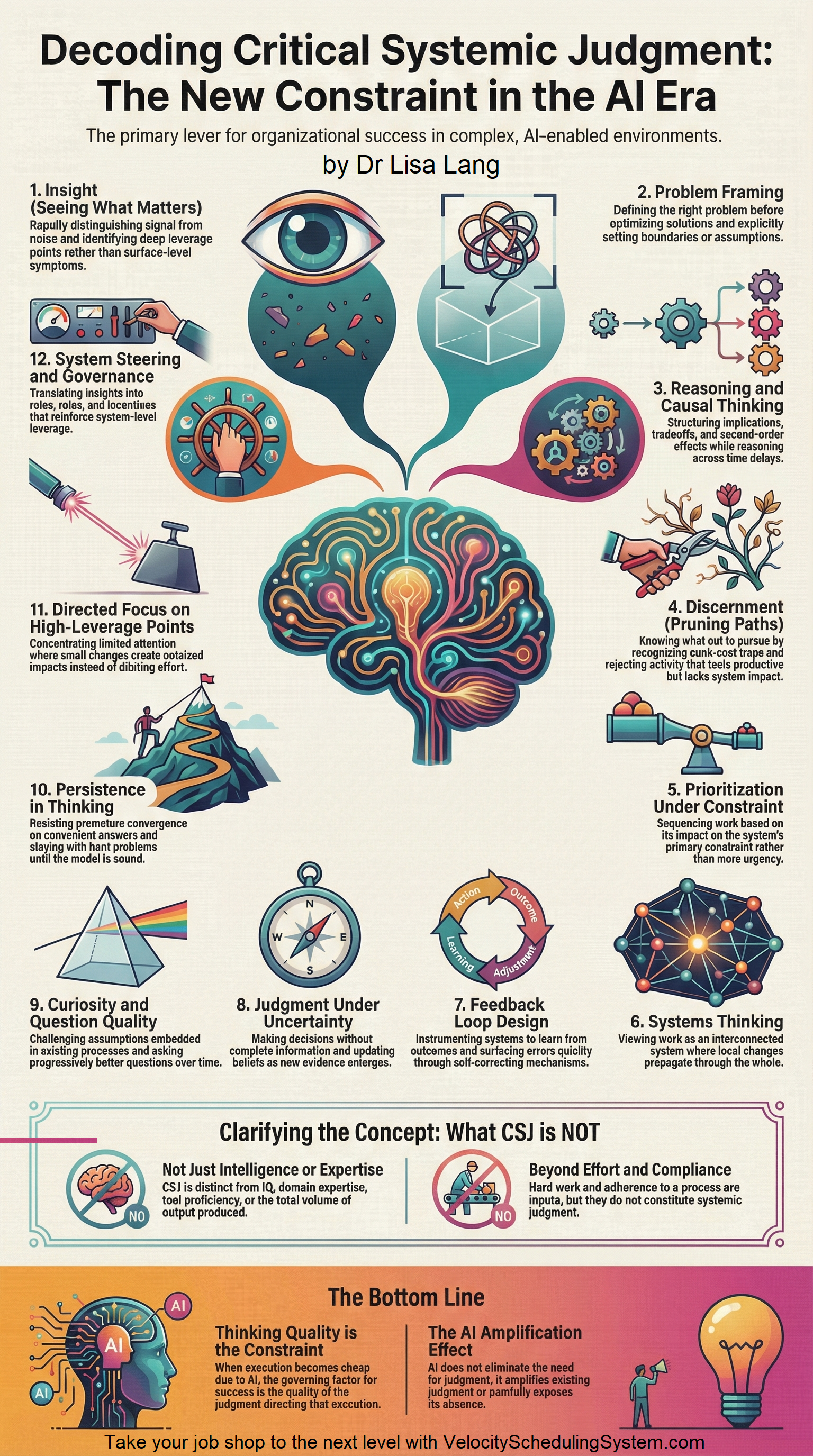
Video Summary of the article
Next: How to Leverage AI in Manufacturing Job Shops (Part 2) – what critical systemic judgment looks like applied on a real shop floor.
 “Dr Lisa” Lang is President of Science of Business, a TOCICO Certified Expert, TOCICO Lifetime Achievement Award recipient, and Past Chairman of the Board of TOCICO. She holds a PhD in Engineering Management from the University of Missouri-Rolla with an emphasis in Manufacturing and Packaging. She was trained by Dr. Eli Goldratt, the father of the Theory of Constraints and author of The Goal, and served as his Global Marketing Director. She has been named a “Manufacturing Trendsetter” by USA Today and a “Manufacturing Champion” by Newsweek. Since 2007, she has applied TOC-based throughput thinking to 550+ job shops through the Velocity Scheduling System (VSS). A 2021 study of 442 VSS shops showed mean results of 198% productivity increase, 87% WIP reduction, 42% on-time delivery increase, and 82% lead time reduction. To learn more, visit velocityschedulingsystem.com.


